
What is the Cognitive Triangle?
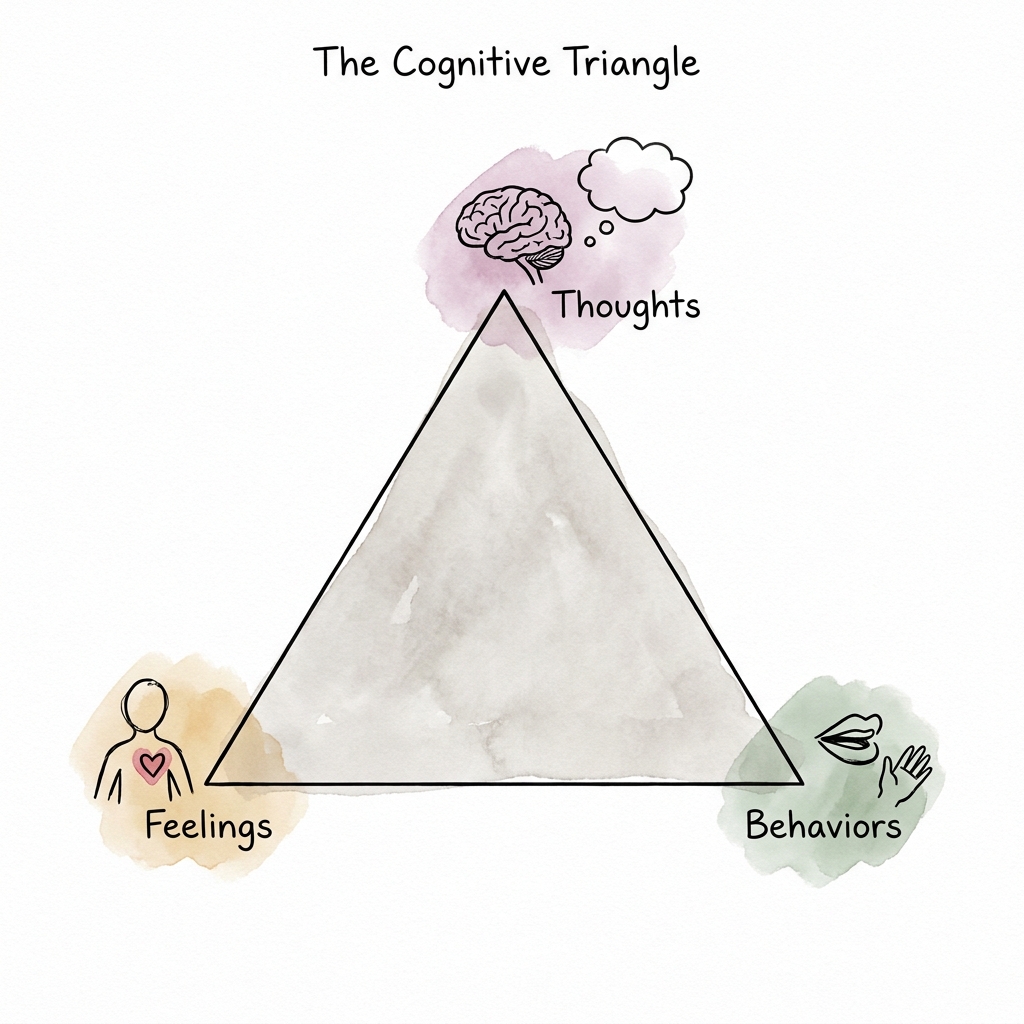
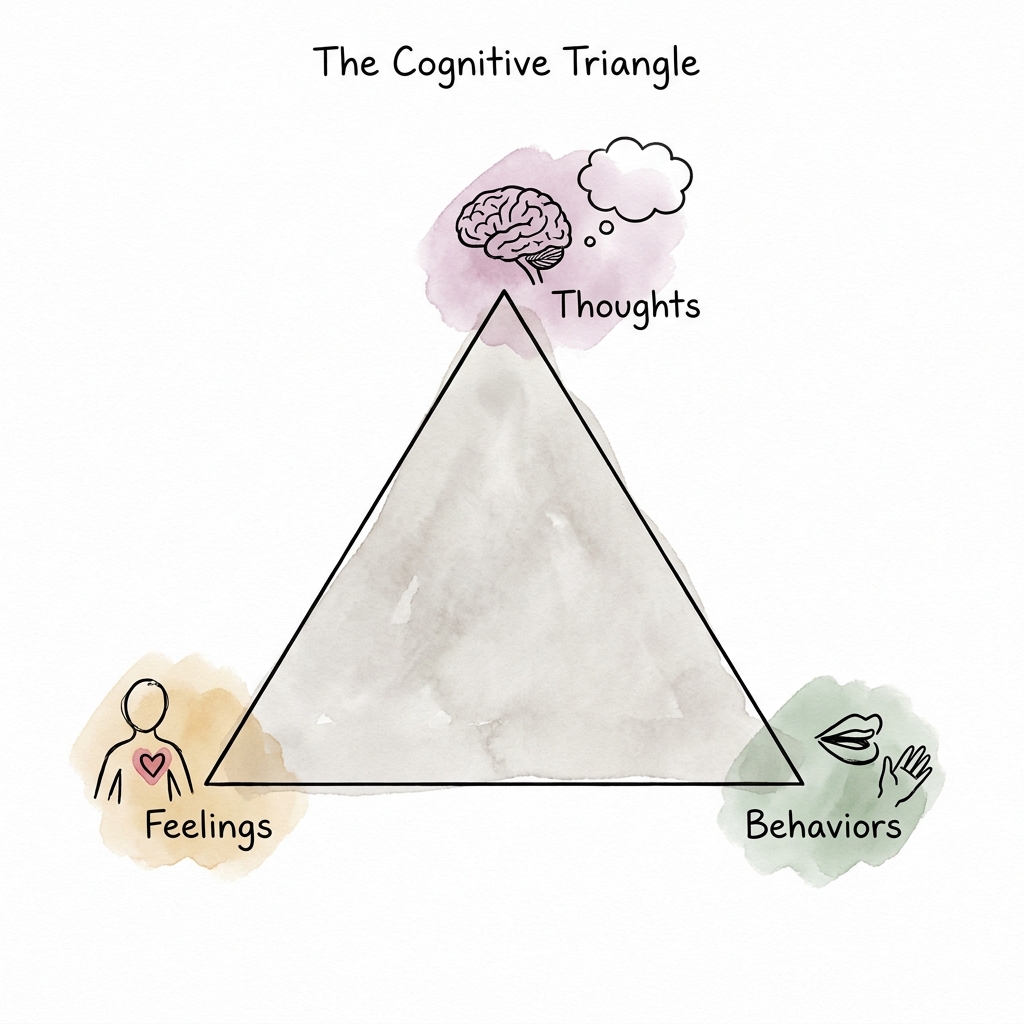
Cognitive Behavioral Therapy (CBT) is a form of psychotherapy developed by Aaron Beck in the 1960s and has been found effective in outcome studies for depression and anxiety disorders. The cognitive triangle constitutes one of the fundamental concepts of CBT. From the CBT perspective, there are three components that make up emotional experience: thoughts, feelings, and behaviors. A situation unfolds, and thoughts about it generate feelings, leading to behaviors that influence the situation positively or negatively. Changing one component results in a chain reaction that changes the others.
How therapists use it
During therapy, patients learn to differentiate the three components of the triangle for any given experience, and a beneficial change in one component can then be observed to affect the others. A therapist introduces the Cognitive Triangle to help a client see how their thoughts, emotions, and behaviors connect. The client then identifies a specific situation and maps the three components, making the pattern visible. This foundation supports further work on thought patterns, emotional responses, or behavioral changes depending on what the client needs most.
Who it's for
CBT commonly helps manage mental health conditions like anxiety and depression. The Cognitive Triangle works well for clients who benefit from a visual, structured way to understand their emotional patterns. It suits those who are ready to see the links between what they think, feel, and do. The activity is less helpful for clients in acute crisis or those who struggle with abstract thinking; in those cases, a therapist may need to introduce the model more gradually or use concrete examples first.
What clients see
The client fills in a situation, then identifies the thought that arose, the emotion that followed, and the behavior that resulted. The worksheet shows how these three elements connect, making the cycle visible on a single page.
List your thoughts, emotions and behaviors
Common questions
When should I introduce the Cognitive Triangle to a client?
The worksheet is recommended as an in-session aid while teaching the CBT triangle. Use it early in treatment to establish the foundation for cognitive work, or whenever a client needs to see how their thoughts, feelings, and actions connect.
What if a client struggles to identify their thoughts?
In the beginning, it is best to complete the worksheet after the situation has passed and some of the dust has settled, and with practice it becomes easier to pause in the middle of a situation to become grounded in the CBT model.
Can the Cognitive Triangle be used for conditions other than anxiety and depression?
CBT has been found effective in outcome studies for depression, anxiety disorders, eating disorders, substance abuse, and personality disorders. The triangle itself is a foundational tool that applies across these conditions.
How does changing one part of the triangle affect the others?
When a person changes their thoughts, they will also change their emotions and behaviors, and by targeting irrational or maladaptive thoughts, mood and behavior can be improved.